Rediscovering an Endangered Cuckoo Bee in Elk Island National Park
By Ilan Domnich and Lisa Neame
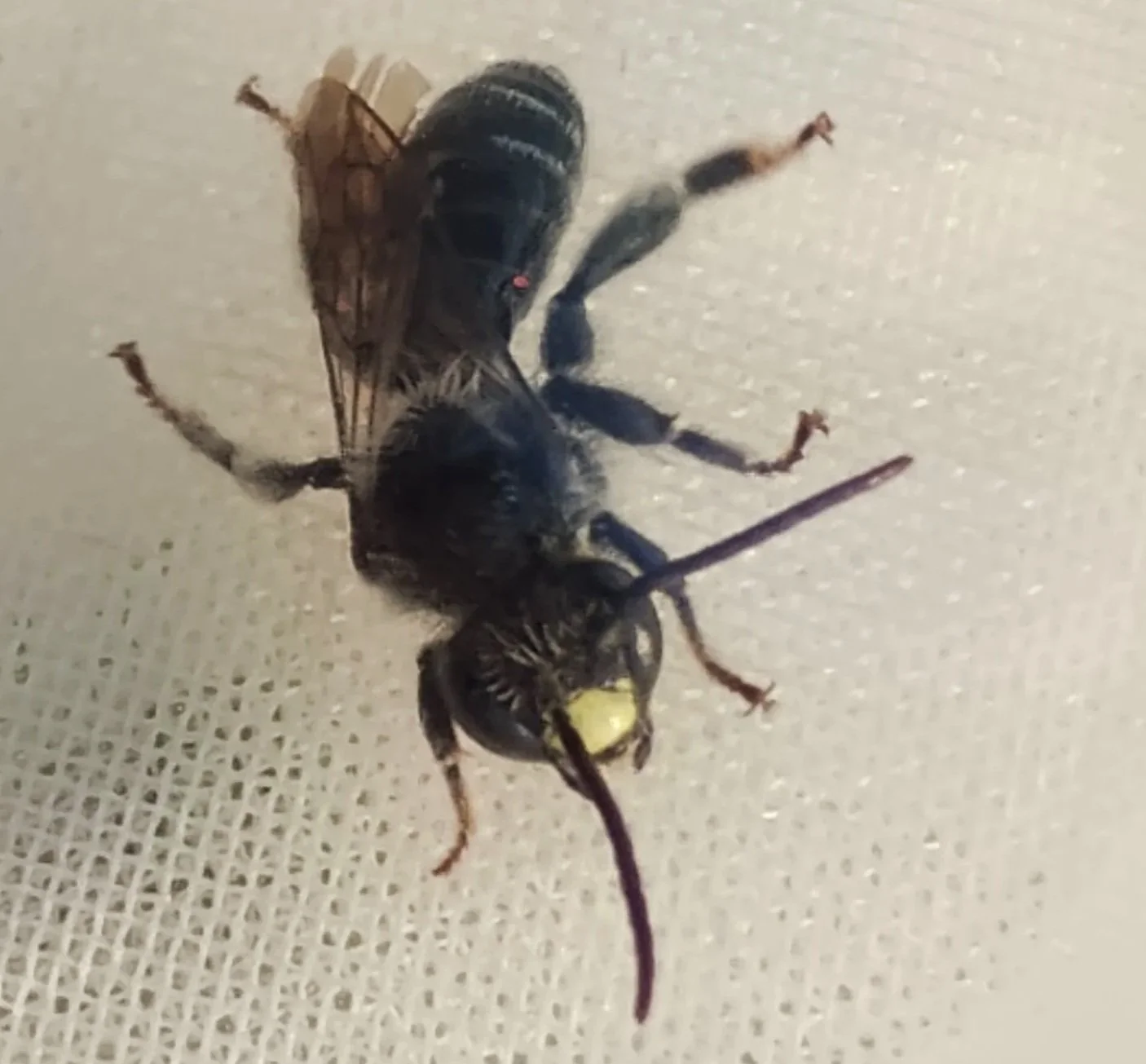
In the summer of 2025, targeted species-at-risk monitoring in Elk Island National Park led to the confirmation of an endangered bee not recorded in Alberta for over a decade. Monitoring surveys led by Lisa Neame, ANBC President with an MSc in ecology specializing in native pollinators, documented the presence of the Macropis cuckoo bee (Epeoloides pilosulus), one of the rarest bees in North America.
More than an exciting rediscovery, this finding underscores the value of habitat-informed monitoring and demonstrates how intact ecosystems can continue to support highly specialized and fragile ecological relationships.
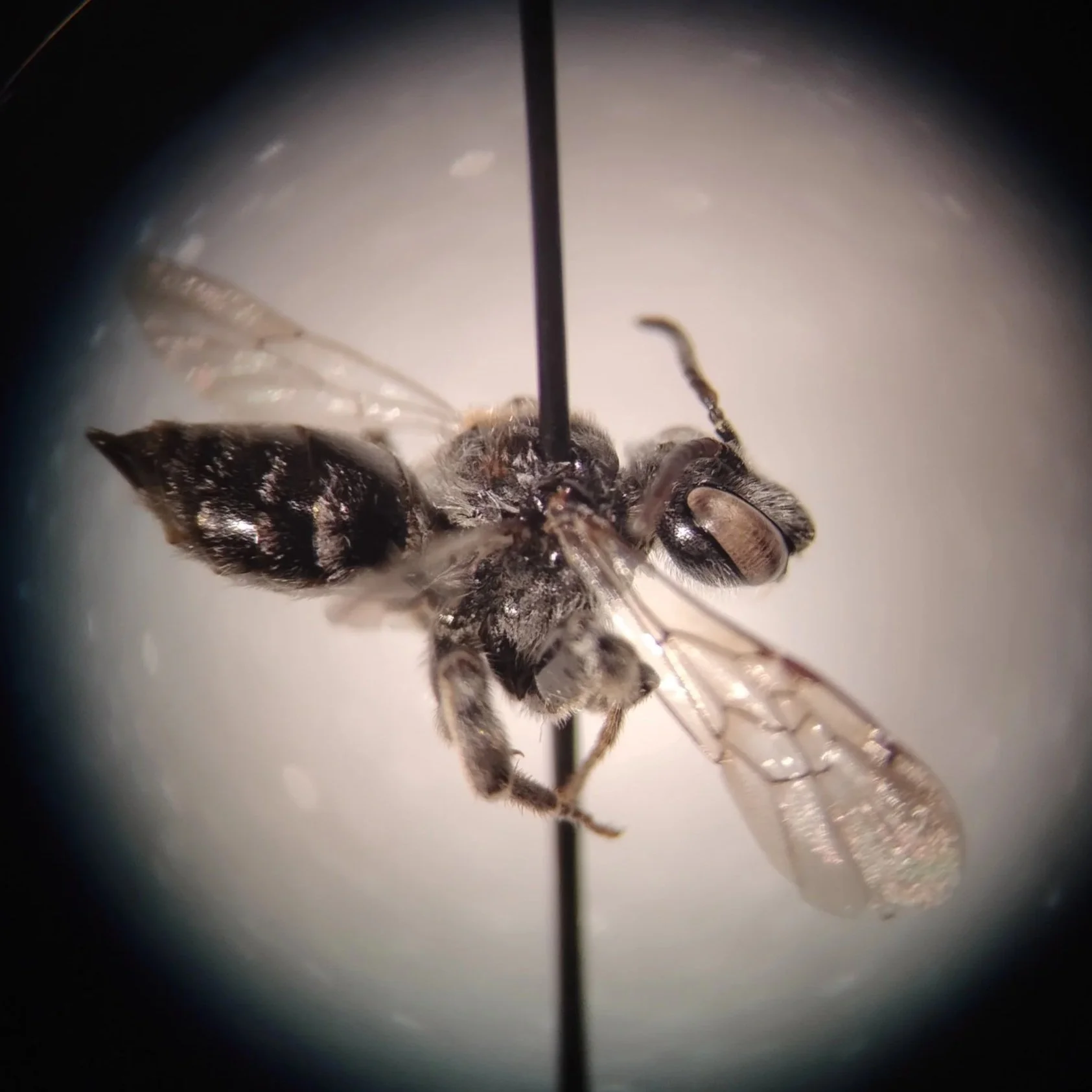
The Macropis cuckoo bee (Epeoloides pilosulus) found in Elk Island National Park (2025). [Photo by Lisa Neame]
A Specialist on a Specialist
The Macropis cuckoo bee is not just rare—it is exceptionally specialized. Unlike most bees, Epeoloides pilosulus does not build its own nest or collect pollen. Instead, it is a kleptoparasite, meaning it lays its eggs in the nests of another bee—in this case, the oil-collecting Macropis bee (Macropis nuda). When the cuckoo bee larva hatches, it consumes the food provisions meant for the host bee’s offspring.
That host bee, in turn, depends on a very particular plant. The plant, Yellow Loosestrife (Lysimachia ciliata), is a native flower that produces floral oils instead of nectar. These oils are collected by Macropis bees as food.
As Lisa explains, this creates a rare three-part dependency, “It’s really a specialist on a specialist. You have the plant, the oil bee that relies on it, and then the cuckoo bee that relies on that bee.”
While Yellow Loosestrife itself is not especially rare, it occurs in small, patchy populations, typically in moist forested areas, which are habitats not often prioritized in biodiversity surveys. Add to that the Macropis bees’ need for nearby sandy soils to nest in, and the result is a very narrow ecological niche where all the elements align.
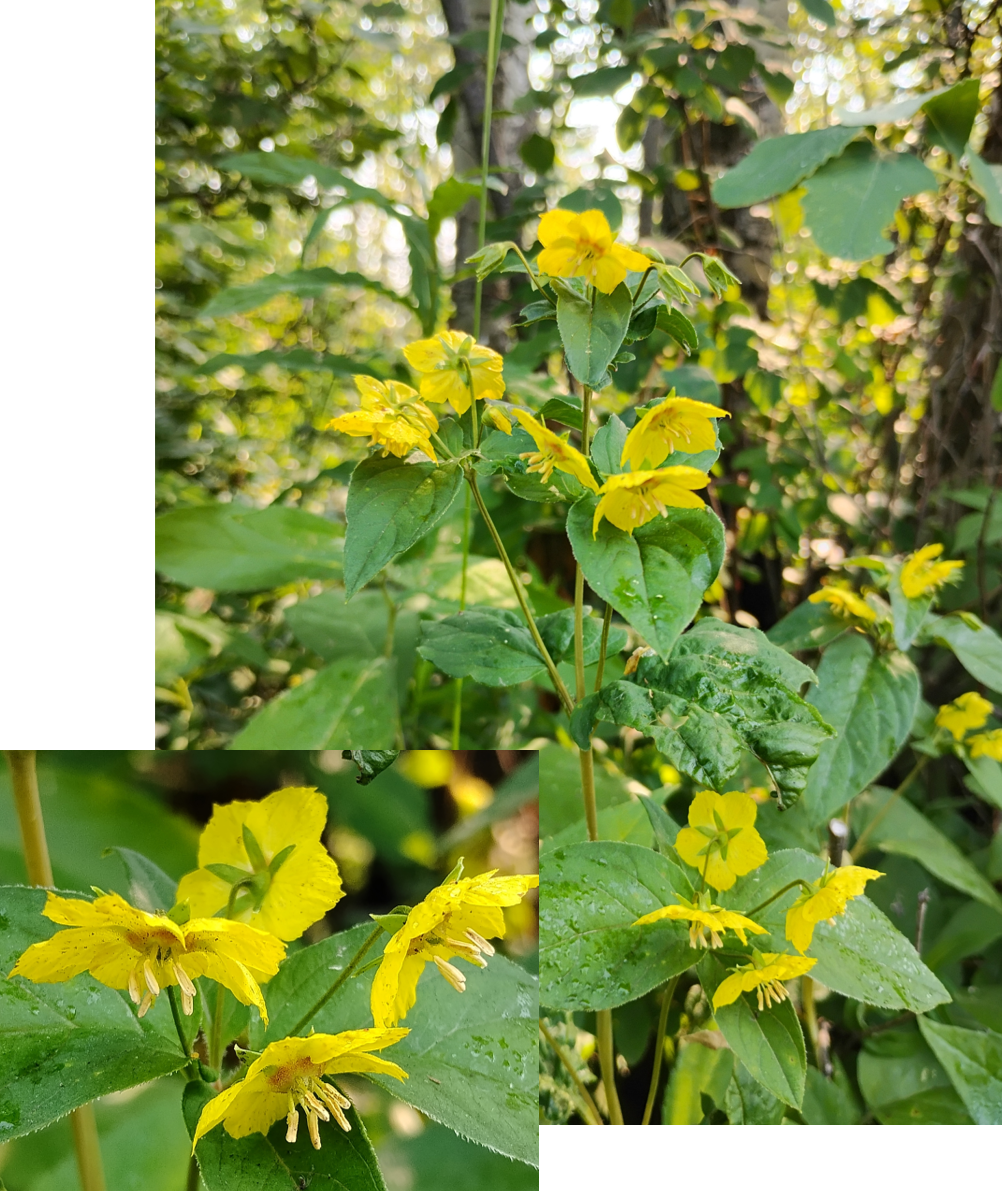
Yellow Loosestrife (Lysimachia ciliata) in Elk Island National Park. [Photo by Lisa Neame]
Why Elk Island?
The last time Epeoloides pilosulus was recorded in Alberta was in 2010, also in Elk Island National Park. That single record made the park a focal point for renewed surveys, especially after the species was listed as Endangered in Canada in 2011.
To target the bee effectively, the ANBC didn’t just look for the cuckoo bee itself. We started with its ecological foundation.
“The main thing guiding our site selection was finding the host plant,” Lisa says. “If you don’t have Lysimachia, you’re not going to have Macropis bees—and without those, you won’t have the cuckoo bee.”
Using a combination of existing datasets, including iNaturalist observations and biodiversity monitoring records, known Yellow Loosestrife patches were located within the park. Importantly, this also highlights the real conservation value of community science platforms like iNaturalist. Plant observations uploaded by the public directly informed endangered species research.
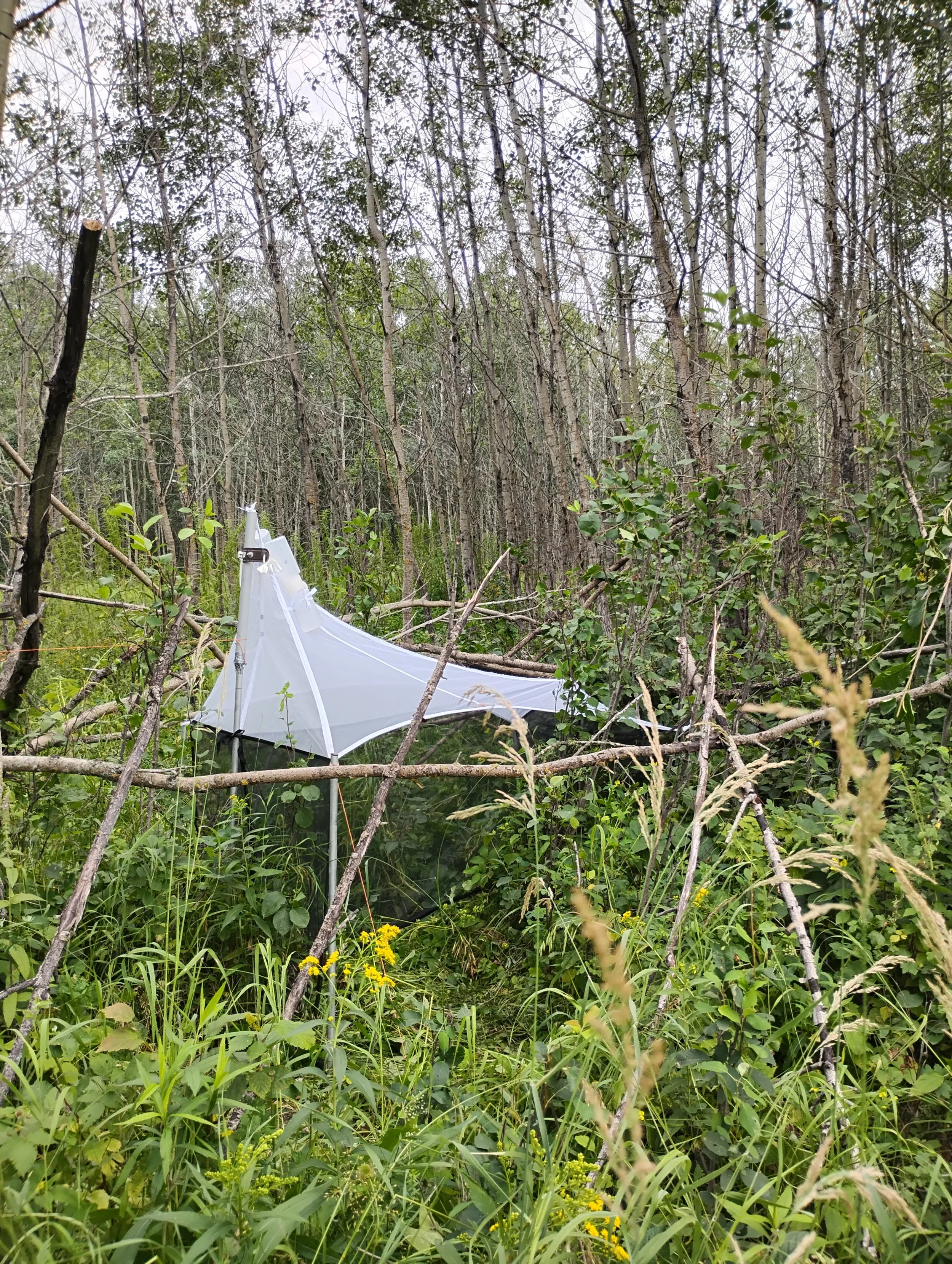
Malaise trap set up in the park with makeshift barrier to repel wildlife. [Photo by Lisa Neame]
Targeted Monitoring Pays Off
Surveying for rare bees in a national park comes with unique challenges. Concerns about wildlife interactions, accessibility of sampling sites and park logistics all shaped the methods that could be used.
Initial efforts in 2024 focused on hand netting and use of malaise traps, since a malaise trap is how the bee was found before—but we had no luck. Rather than giving up, the team adapted. In 2025, with better knowledge of plant locations and potential host bee nesting habitat, the ANBC expanded sampling to include pan traps, placed strategically near sandy soils close to Yellow Loosestrife patches.
That adjustment made all the difference. The bee itself wasn’t immediately obvious. Like many small, black solitary bees, it had to be pinned, labelled, and examined under a microscope to get an identification—but once Lisa saw it, she knew.
“Kleptoparasitic bees just have a look about them, they’re a little different.” she says. “Once you’ve seen enough bees, you recognize it.”
How Rare Is Rare?
Macropis nuda, a solitary bee that serves as the host species for the Macropis cuckoo bee. [Photo by Lisa Neame]
According to a comprehensive review of Canadian records in 2018, only 12 specimens of Epeoloides pilosulus have ever been documented in Canada, with the westernmost records occurring right here in Alberta (Sheffield and Heron, 2018). That tiny number is part of why the species was listed as endangered. At the same time, Lisa cautions that rarity doesn’t always tell the full story.
“I think part of the reason we have so few records is that we haven’t been looking in the right habitats,” she explains. “Moist forests aren’t where people typically survey bees.”
Lisa mentioned that while looking for Lysimachia is a start, after surveying multiple plant populations it was clear that not all host plant populations support the Macropis host bees.
As more targeted surveys take place, additional records may suggest that while the species is certainly quite uncommon, it’s possible it may be under-detected rather than on the brink of disappearance.

The Macropis cuckoo bee (Epeoloides pilosulus) found in Elk Island National Park (2025). [Photo by Lisa Neame]
A Sign of a Healthy Ecosystem
So why does finding one tiny, obscure bee matter?
Species like the Macropis cuckoo bee act as indicators of ecosystem health. If a landscape can support a native oil-producing plant, a specialist bee that relies on it, and a parasite that depends on that bee, all in close proximity, it suggests that the habitat is healthy, intact and functioning.
“When you see these complex trophic relationships persisting,” Lisa says, “that’s a really good sign that the ecosystem is healthy.”
Elk Island National Park’s ability to support this full chain reinforces its role as a refuge not just for large mammals and birds, but also for some of the province’s most vulnerable and least visible species.
What Comes Next?
This discovery marks not an endpoint, but a new beginning. Moving forward, we expect that efforts will focus on surveying additional Yellow Loosestrife sites in areas around Elk Island National Park and within the Beaver Hills Biosphere and across Alberta, mapping the distribution of Macropis bees more precisely, and refining our understanding of how and where Epeoloides pilosulus persists. With stronger data, conservation actions can shift towards targeted, evidence-based habitat protection.
For ANBC, this find serves as a powerful reminder of the importance of stewardship, monitoring, and collaboration. Conservation of species at risk calls for looking beyond the obvious, and to pay attention to what often escapes notice.
References:
Sheffield C, Heron J (2018). A new western Canadian record of Epeoloides pilosulus (Cresson), with discussion of ecological associations, distribution and conservation status in Canada. Biodiversity Data Journal 6: e22837. https://doi.org/10.3897/BDJ.6.e22837