
Identifying Wild Bees
How can you tell it’s a bee?
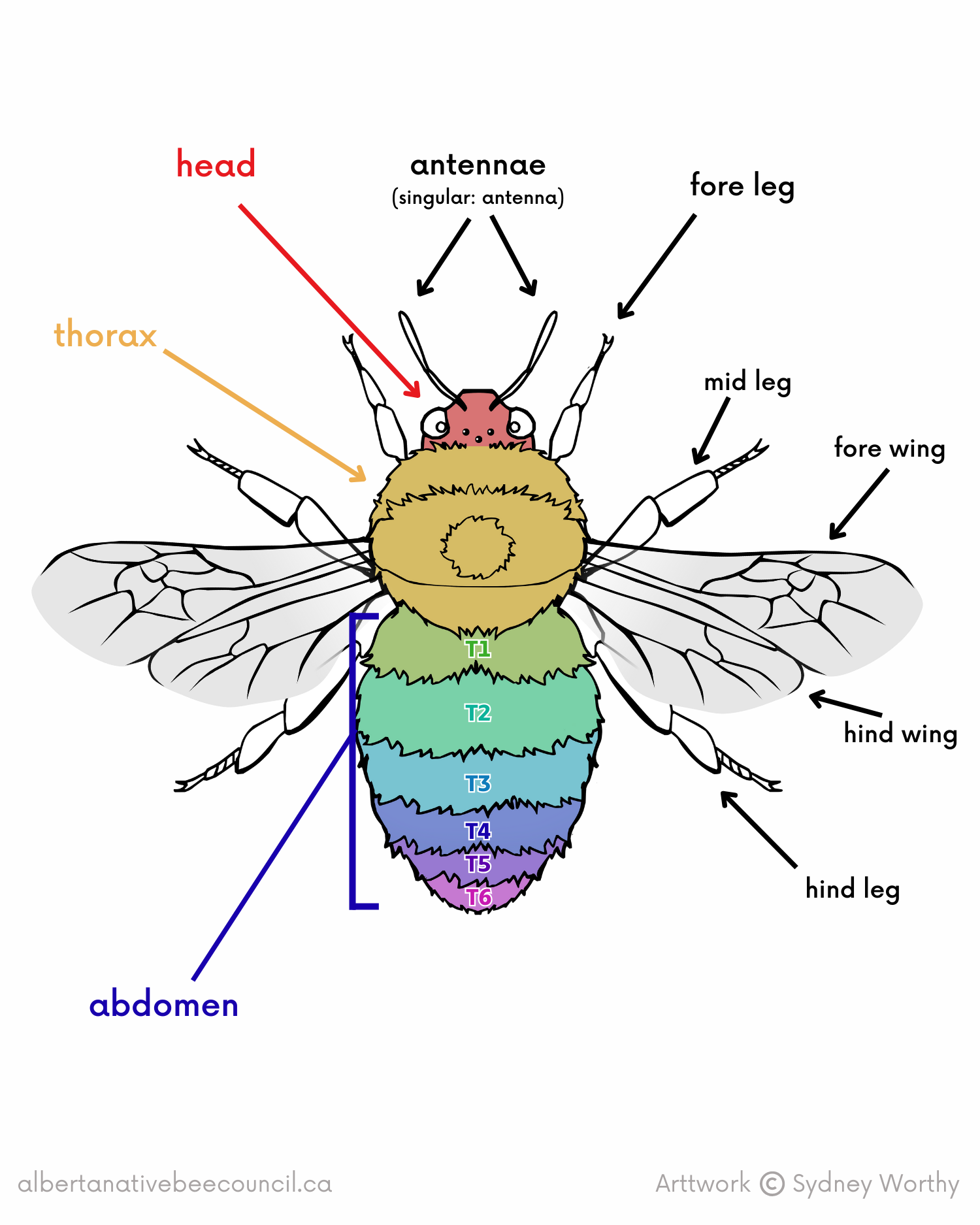
Like all insects, bees have three main body parts: head, thorax and abdomen. Attached to their thorax are six legs and two pairs of wings (some insects, like beetles and flies, only have one pair of wings).
Many bees in Alberta have furry bodies (unlike many wasps) for trapping loose pollen. Most types of female bees have a structure (called a scopa) that they use to carry pollen back to their nests. Bumblebees, for example, have a basket-like structure on their hind legs (called a corbicula) where they pack pollen. Megachilid bees (leafcutter bees) collect pollen on their scopa, which is on the underside of their abdomens. Other types of bees have a scopa on their upper hind legs .
Male bees and cuckoo bees aren’t responsible for collecting pollen and don’t have a scopa or corbicula. Males also have an additional antennal segment and abdominal segment compared to females.
Bumble bees are often determined by colours. While each species can have a variety of colour variations, called morphs, they usually have one or two common colours. The abdominal segments, called terga, are referred to as T 1-6 (T1-7 for males) when describing colour morphs. Hair colour on the face and thorax also are considered when identifying bumble bees.
See our bumble bee ID guides below!
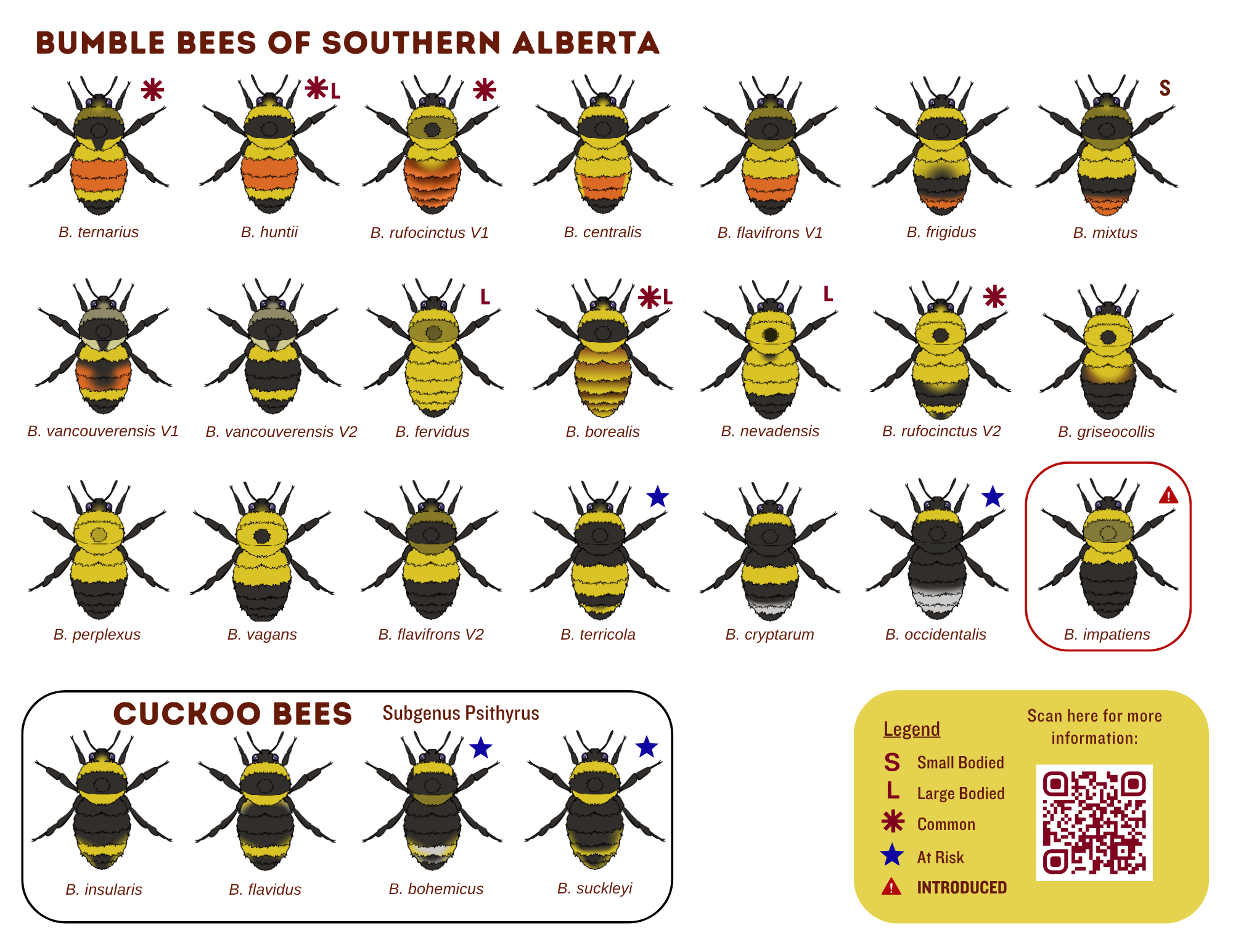
Bumble bee Identification Guides

There are at least 30 species of bumble bees found in Alberta.
We’ve developed guides for identifying the common ones in central Alberta and in southern Alberta, which can be found below:
Alberta’s solitary bees
Most bees in Alberta are solitary bees, but with over 340 species, identification can be a challenge.
Find out what bee families and species we have in Alberta on our Native Bees Page.
If you want to get more familiar with bee identification, consider purchasing a bee guide, such as this guide to the bees of North America.